

Home Blog

The CDC Has a New Leader—After Months of Chaos at the Top

0

CDC Musical Chairs Hero Image

Meta description: Erica Schwartz CDC nomination is the latest twist in the Trump CDC director 2026 saga, and it says everything about CDC leadership instability, hiring theater, and the kind of dysfunction we cover in unfiltered workplace news.

If you’ve ever felt like your company’s HR department was running a disorganized game of "whose job is it anyway," take a breath and look at the Centers for Disease Control and Prevention (CDC). While most professionals are worried about a bad performance review or a passive-aggressive Slack message, the leadership at the CDC is currently experiencing the ultimate corporate horror story: the high-stakes, low-stability, public-facing dumpster fire of leadership turnover.

President Donald Trump has just nominated Dr. Erica Schwartz to lead the agency. On paper, she’s a powerhouse: a former Deputy Surgeon General, a retired Coast Guard Rear Admiral, and a woman who holds both an MD and a JD. Reuters, NPR, and Axios have all reported on the nomination and the broader mess surrounding the agency’s leadership churn. But in the current political climate, those credentials might just be the armor she needs to survive a workplace that has chewed up and spat out its last two leaders faster than a tech startup burns through VC funding.

This isn’t just a political story; it’s a masterclass in hiring theater and workplace instability.

Erica Schwartz CDC Nomination Context: CDC Leadership Instability in Plain Sight

The Revolving Door at CDC

To understand why Schwartz is stepping into a minefield, we have to look at the seats already left cold. The CDC hasn't had a permanent, Senate-confirmed director in nearly eight months. In the world of unfiltered workplace news, this is what we call a "red flag."

First, there was Dave Weldon, the former Florida congressman who was the administration’s first pick. He withdrew before the process even got off the ground because it was clear the Senate wasn't going to play ball. Then came Susan Monarez, who actually took the helm: only to be fired after a staggering four weeks. That broader timeline of CDC leadership instability has been tracked across reporting from Reuters, NPR, and Axios. For those keeping score at home, that’s less time than most people spend in an onboarding program or waiting for their first health insurance card to arrive in the mail.

Monarez reportedly clashed with Health Secretary Robert F. Kennedy Jr. over vaccine-related demands. When the person you report to has a fundamentally different philosophy than the entire mission of the agency you lead, you aren't a leader; you’re a placeholder. Monarez found that out the hard way. Since then, Jay Bhattacharya has been the "acting" director, a role that is essentially the corporate equivalent of being a long-term temp with a fancy title but no actual job security.

Who Is Erica Schwartz? The Rear Admiral at the Center of the CDC Nomination

Erica Schwartz Military and Legal Background

If anyone is built to handle this level of workplace toxicity, it might be Erica Schwartz. Her resume reads like a checklist for someone who expected to go to war: both literally and legally.

  • The MD: She graduated from Brown University and understands the science.
  • The JD: She graduated from the University of Maryland and understands the law.
  • The Rank: As a Rear Admiral in the Public Health Service, she’s used to a chain of command and high-pressure environments.

But here’s the Employerish take: being qualified for a job and being allowed to do the job are two very different things. Schwartz has already been on the front lines of this particular drama. In September 2025, she testified before a Senate committee that RFK Jr. had pressured her to dismiss vaccine officials without cause.

Now, in a twist of corporate irony that would make a Netflix drama writer blush, RFK Jr. is the one celebrating her nomination. This is the ultimate "awkward elevator ride" scenario. Imagine testifying against your future boss’s management style and then having that same boss "look forward to working together." That’s not just a job; that’s a survival challenge.

Trump CDC Director 2026 Drama and the Myth of the "Permanent" Role

In the modern workplace, we are often sold the lie of "stability." We’re told that if we get the right degrees (like Schwartz's MD and JD) and put in the years (like her military service), we’ll reach a level of career safety.

The CDC situation proves that no one is safe from the theater of leadership. When the mission of an organization becomes secondary to the political whims of its stakeholders, the professionals at the top become collateral damage.

At Employerish, we advocate for Dualpreneurship. This is the idea that your job is just one income stream, and your primary responsibility is to your own personal brand and financial security. Schwartz is a perfect example of this in action. She isn't just a government employee; she is a highly specialized professional with multiple backup plans. If the CDC gig goes south: which, statistically, it might: she has the legal and medical credentials to pivot instantly.

CDC Leadership Instability and Hiring Theater: Why They Keep Failing

Clashing Forces at CDC

Why is the CDC struggling to keep a leader? It’s the same reason your local mid-sized company can’t keep a Marketing Director: unclear expectations and toxic oversight.

When the hiring process is more about "fit" (read: political alignment) than "function" (read: public health), you end up with a revolving door. The CDC is currently a workplace where the employees are likely paralyzed by the "musical chairs" at the top. Imagine trying to run a national health agency when you don't know who your boss will be next month, or if the current boss is about to be fired for disagreeing with a Secretary who has a vendetta against your core functions.

This kind of instability trickles down. It creates a culture of fear, where middle management stops making decisions because they don't want to be on the wrong side of the next leadership "restructuring."

What Erica Schwartz’s CDC Nomination Teaches Anyone Stuck in Workplace Chaos

Whether you're a nurse, a software engineer, or a Rear Admiral, the lessons from the CDC’s leadership crisis are universal:

  1. Beware the "Dream Job" with a Nightmare Boss: No amount of prestige is worth a role where you are set up to fail. If the reporting structure is fundamentally broken (like the Schwartz/RFK Jr. dynamic), the job will eventually become a burden.
  2. Your Resume is Your Armor: Schwartz’s dual degrees and military background aren't just for show; they are her exit strategy. She can work anywhere. Can you?
  3. Recognize Hiring Theater: If a company has had three "nominations" or hires for the same role in a year, the problem isn't the candidates: it's the company.
  4. The "Boomerang" is Real: Schwartz is returning to a world she already knows. In 2026, returning to a previous employer (even a government one) isn't a sign of failure; it’s a strategic move if you have the leverage to demand better terms.

Erica Schwartz CDC Nomination: What Happens in the Confirmation Fight

Schwartz still has to face Senate confirmation. This won't be a walk in the park. She’ll be grilled about her previous testimony, her stance on vaccines, and how she plans to navigate the RFK Jr. relationship.

For the rest of us, this is just more proof that the "corporate" world (even the government version of it) is often just a high-budget soap opera. We’re watching to see if the Admiral can steady the ship or if she’ll be the next person looking for a "career break" on LinkedIn in six weeks.

The Employerish Take Summary Image


The Employerish Take

The CDC nomination isn't about public health: it's about power dynamics and hiring theater. Erica Schwartz is clearly qualified, but in a workplace where "loyalty" to a superior's agenda outweighs scientific integrity, qualifications are often secondary. This is a reminder to every professional: never get too comfortable in a chair, because the music could stop at any moment. Build your brand, diversify your skills, and always keep your exit strategy polished. Stability is a myth; leverage is the only thing that's real.

Sources: Reuters on Schwartz as the White House’s CDC pick, Reuters on Trump’s nomination announcement, NPR on Erica Schwartz’s CDC nomination, Axios on Trump nominating Schwartz to lead the CDC, Axios on the White House weighing Schwartz amid CDC turnover

Tired of corporate propaganda? Join the Employerish community for more unfiltered takes on the stories that actually matter to your career.
Meta’s AI Hunger Games: Why 8,000 Humans Are Getting the Boot in May

0

Meta Layoffs AI Infrastructure

If you still believe the corporate myth that "our people are our greatest asset," it’s time to wake up. At Meta, that "asset" is currently being liquidated to pay for silicon chips and server racks.

While the tech world was busy obsessing over the latest LLM benchmarks, Mark Zuckerberg’s empire quietly dropped a bombshell: approximately 8,000 employees: roughly 10% of the remaining workforce: are slated to be shown the door on May 20th. Internal memos are calling it "AI-driven restructuring." We’re calling it what it actually is: the May 20th Massacre.

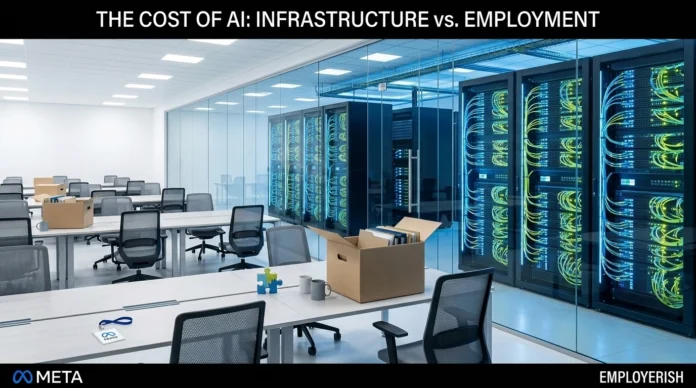
This isn't a case of a company struggling to keep the lights on. This is a cold, calculated trade-off. Meta is essentially firing 8,000 humans so they can afford a $135 billion bill for AI infrastructure. It’s the ultimate Hunger Games, and the odds are definitely not in the employees' favor.

The $135 Billion Trade-Off

Let’s look at the math, because the numbers tell a story that the PR department never will. Meta is reportedly investing a staggering $135 billion into AI servers, data centers, and the high-end hardware required to train the next generation of algorithms.

To put that in perspective, $135 billion is enough to pay those 8,000 employees their current salaries for several decades. But humans don't scale like GPUs. Humans need health insurance, maternity leave, and the occasional day off to avoid a mental breakdown. Servers? They just need electricity and liquid cooling.

AI Scaling vs Human Cost

By dumping $135 billion into "efficiency" while cutting the very people who built the platform’s current success, Meta is sending a clear signal: The era of the "knowledge worker" is being replaced by the era of the "model trainer," and even those roles are on thin ice.

The "Efficiency" Lie

In the corporate world, "efficiency" is the ultimate gaslighting term. It’s the word CEOs use when they want to tell Wall Street they’ve found a way to squeeze more blood from the stone.

When Zuckerberg talks about the "Year of Efficiency" (which has now apparently turned into the "Decade of Efficiency"), he isn't talking about better workflows or fewer meetings. He’s talking about shifting the payroll budget into the capital expenditure budget.

Every time a human is replaced by an automated system, the stock price gets a little bump. Why? Because algorithms don't ask for raises. This isn't about making the company "better" for the users; it’s about pumping stock prices to ensure executive bonuses remain in the stratosphere. While 8,000 families are wondering how they’ll pay their mortgages come June, the upper echelon is measuring their yachts for new curtains.

A Systemic Rot: You’re Not Alone

Meta isn't the only one playing this game. This is a systemic rot that is spreading across the entire tech landscape.

  • Amazon is reportedly eyeing another 14,000 cuts in May, following their massive 16,000-person purge in January. They’re funneling $125 billion into their own AI infrastructure.
  • Block (formerly Square) has been aggressively pruning its workforce under the same "efficiency" mandate, proving that even the "disruptors" are just as susceptible to old-school corporate bloodletting.

"AI" has become the new convenient excuse for old-school corporate pruning. In 2008, it was "the housing crisis." In 2020, it was "the pandemic." In 2026, it’s "the AI transition." The excuse changes, but the result is always the same: the people at the bottom pay for the pivots at the top.

Corporate Greed and Exec Bonuses

The "Professional Troublemaker" Perspective: Your Job is an Income Stream

Here is the unfiltered truth that your HR department will never tell you: Your job is not your identity. It is an income stream.

At Employerish, we advocate for Dualpreneurship. In an era where 10% of a company can be deleted with a single press release, relying on one employer for your entire livelihood isn't just risky: it’s professional malpractice.

The "loyalty" that corporations demand is a one-way street. They want your 60-hour weeks, your passion, and your creative "soul," right up until the moment a GPU can do 70% of your job for 5% of the cost.

It is time to normalize "boomeranging." Go to corporate, get the bag, learn the skills, and then leave on your own terms: or stay just long enough to build your own side hustle. If Meta can treat 8,000 people like line items on a spreadsheet, you have every right to treat Meta like a high-paying client that you can fire at any time.

Dualpreneurship Lifestyle

Don't Get Caught in the Crosshairs

The May 20th Massacre at Meta is a wake-up call for everyone in the digital economy. Whether you're in Menlo Park or working remotely from a beach in Bali, the "AI Hunger Games" are coming to a Slack channel near you.

The goal isn't to live in fear; the goal is to live with your eyes open. Stop buying into the "we’re a family" propaganda. Start building your own safety net. Start treating your career like a business, and your employer like just one of many stakeholders.

If you’re one of the 8,000, don’t let the "efficiency" lie get in your head. You weren't "inefficient." You were just more expensive than a server rack in a cooling shed in Iowa. That’s not a reflection of your value; it’s a reflection of Meta’s priorities.

Stay sharp. Stay cynical. Stay Employerish.


The Employerish Take

Meta is cutting 8,000 roles (10% of staff) on May 20th to fund a $135 billion AI infrastructure spend. This isn't "efficiency": it’s a calculated replacement of humans with hardware to satisfy Wall Street. This trend is systemic, with Amazon and Block following suit. The Takeaway: Your job is an income stream, not a marriage. Diversify your income, embrace dualpreneurship, and never trust a CEO who uses the word "efficiency" while holding a pink slip.

Looking for workplace news that actually tells the truth? Subscribe to Employerish for more unfiltered takes on the corporate theater.

Stop Wasting Time on 6-Round Interviews: Try These 5 Hacks to Spot a Toxic Workplace Early

0

You’ve updated your resume, optimized your LinkedIn for the 2026 algorithm, and finally landed a "discovery call." Then comes the calendar invite for Round 2. Then Round 3. By the time you’re being asked for a "culture fit" chat in Round 6 with a Senior VP who seems to have forgotten your name, you aren't just tired, you’re being gaslit.

Welcome to the era of Hiring Theater.

In 2026, the traditional interview process hasn't just slowed down; it has become a sadistic endurance test. Companies are no longer looking for the best talent; they are looking for the most compliant. If you’re willing to jump through six hoops for a mid-level marketing manager role, they know you’ll probably tolerate their "mandatory fun" Thursdays and unpaid overtime later.

At Employerish, we call this what it is: a giant waste of your most valuable asset, your time. It’s time to stop being a "grateful candidate" and start being a Professional Troublemaker.

The Dark Reality: Why the Process is Broken

Before we dive into how to escape the madness, you need to understand why companies are doing this. It isn’t incompetence (well, not just incompetence). It’s strategic.

First, there’s the "Under 50" strategy. Many organizations are terrified of the post-2024 economic shifts and are keeping headcount artificially low. They post "ghost jobs" and conduct endless interviews to look like they’re growing, while actually having zero intention of hiring anyone until someone else quits. It’s a vanity project for HR departments to prove they’re still "needed."

Second, we have the rise of Invisible Layoffs. Instead of paying severance packages, companies are making existing roles so miserable that people quit. To fill the gaps, they run candidates through 6+ rounds of interviews to find the most desperate person, the one least likely to push back when they’re eventually asked to do the work of three people.

If you find yourself in a marathon hiring process, you aren't just looking for a job; you’re looking at a toxic workplace culture in the making. Here are 5 hacks to spot the rot before you sign the contract.


1. The 'Panel Disconnect'

Panel Disconnect

During Round 3 or 4, you’ll likely face a panel interview. This is where the office politics drama starts to leak out. Pay close attention to how the interviewers interact with each other.

Do they disagree on what the primary goal of the role is? Does the direct manager say the job is about "innovation," while the HR rep insists it’s about "compliance and process"?

If the people who will be your peers and bosses can’t agree on why the role exists while you’re in the room, imagine the chaos once you’re on the payroll. This disconnect is a massive red flag. It means the leadership is fragmented, and you will spend 80% of your time navigating their conflicting egos instead of actually working.

2. The 'Vague Pay-Out'

Salary transparency was supposed to be the law of the land by 2026, yet many companies still treat compensation like a state secret. If you reach Round 3 and the recruiter is still saying things like, "We’re competitive based on experience" or "We’ll discuss the package at the final stage," run.

A company that hides the bag is a company that plans to lowball you. In the world of dualpreneurship, your job is an income stream, period. If a client for your side hustle refused to give you a quote until you did six hours of free work, you’d block them. Treat your employer the same way. Demand a range early. If they won't give it, they don't value your time.

3. The '3+ Round Rule'

The 3+ Rule

Here is a hard truth: Anything over 3 rounds is a sign of indecisive leadership.

Research shows that most hiring decisions are made subconsciously within the first 20 minutes of meeting a candidate. The subsequent rounds are usually just "consensus building", which is corporate-speak for "nobody wants to take responsibility if this hire fails."

If a company needs six people to sign off on a new hire, they will need six people to sign off on your every project, expense report, and vacation request. You aren't entering a "collaborative environment"; you’re entering a bureaucracy where nothing ever gets done. This is one of the most overlooked workplace red flags. Decision paralysis at the top always leads to burnout at the bottom.

4. The 'Stressed-Survivor Vibe'

Stressed Survivor

Stop looking at the fancy espresso machine in the lobby and start looking at the eyes of the people interviewing you. Do they look like they’ve slept in the last forty-eight hours? Are they checking their Slack notifications every thirty seconds while you’re talking? Do they mention "fast-paced environment" more than three times?

"Fast-paced" is almost always code for "we are severely understaffed and everyone here is on the verge of a breakdown." In 2026, with the prevalence of remote and hybrid models, if the in-office team looks like a cast of The Walking Dead, it’s because the culture is parasitic. They don’t want a new colleague; they want a new organ donor to keep the machine running.

5. The 'Bait-and-Switch'

Bait and Switch

The final hack is spotting the vague growth path. You ask about the next two years, and they give you a word salad about "opportunities for those who take initiative."

If they can’t define what success looks like or what the specific path to a promotion is, it’s because there isn't one. Many companies use multi-round interviews to build up a "bench" of talent they can pull from later, or they hire you for a "Senior" role with "Junior" pay and "Director" responsibilities.

If the job description you applied for starts morphing by Round 5 into something completely different, you’re being baited. They’re hoping that because you’ve already invested 10+ hours into the process, you’ll be too "committed" to walk away when the role turns out to be a dead-end.


The Employerish Insight: Embrace Dualpreneurship

The reason we get stuck in these 6-round nightmares is that we’ve been conditioned to believe we need the company more than they need us. We treat a job like a lifestyle or a family.

It’s time to shift the perspective. Your job is a contract. It is one of your income streams. When you view your career through the lens of dualpreneurship, the power dynamic changes. If a company wants to waste six weeks of your life on "Hiring Theater," you have the leverage to say no because you aren't putting all your eggs in their toxic basket.

Normalize "boomeranging." If you realize three months in that you ignored these red flags, don't "tough it out" for the sake of your resume. Go back to your previous employer, pivot to a new stream, or move on. The "loyalty" trope died in 2024.

The Employerish Take

Stop playing the role of the "eager applicant" in their corporate play. The minute an interview process hits Round 4 without a firm offer or a clear salary discussion, you are no longer being interviewed: you are being tested for your tolerance of dysfunction.

The TL;DR:

  • 3 Rounds is enough. If they can't decide by then, they never will.
  • Vague pay is a lowball. Don't work for secrets.
  • Stressed interviewers = Toxic culture. Their future is your present.
  • Hiring Theater is real. Don't be a free extra in their production.

Be a Professional Troublemaker. Ask the hard questions in Round 1, and if they flinch, walk away. Your time is the only thing you can't earn back.


Are you currently stuck in Round 7 of a "Culture Fit" marathon? Tell us your horror stories in the comments: we might just feature your workplace drama in our next unfiltered deep dive.

Spirit Airlines Liquidation: The $100M Corporate Bait-and-Switch That’s Stranding Everyone

0

Spirit Airlines Liquidation Hero

If you’ve been paying attention to the skies, or your newsfeed, over the last 48 hours, you’ve witnessed one of the most aggressive corporate faceplants in modern aviation history. Spirit Airlines, the budget carrier everyone loves to hate but many rely on, isn't just "restructuring" anymore. We are looking at a total liquidation as early as this week, a possibility CNBC reported as the airline’s cash crisis got uglier by the day.

While the headlines are obsessed with stranded spring breakers and the sudden death of the ultra-low-cost model, the real story isn't in the terminal. It’s in the cockpit, the galley, and the breakrooms. This isn't just a market shift or a "tough season" for fuel. This is a masterclass in corporate failure, executive incompetence, and a $100 million bait-and-switch that has left 15,000 employees holding a bag of empty promises. It’s exactly why keywords like Spirit Airlines bankruptcy 2026, Spirit Airlines liquidation, Spirit employees stranded, pilot furloughs, and corporate failure are dominating the conversation.

The Corporate Whiplash: Recalled to be Fired

To understand the level of systemic failure here, we have to look back exactly one month. In March 2026, Spirit Airlines made a bold, public-facing move: they recalled 500 pilots from furlough, a move FlightGlobal covered before this whole mess escalated into a full-blown Spirit Airlines liquidation disaster.

Think about that for a second. Imagine being a pilot who had spent months navigating the uncertainty of the aviation industry, finally getting that call to return to the flight deck, only to have the entire company vanish from the face of the earth 30 days later. This wasn't just optimism; it was negligence. You don’t recall 500 specialized professionals into a burning building unless you have no idea where the exits are, or worse, you’re using their return to mask the smoke from investors. That’s not workforce planning. That’s corporate failure with a scheduling system.

The "Spirit Airlines bankruptcy 2026" narrative has evolved from a slow burn to a flashover. While management was patting themselves on the back for "restoring capacity," the reality was that they were flying straight into a liquidation storm they should have seen coming months ago.

Stressed Pilot Terminal

The $100 Million Sacrifice That Meant Nothing

Here is the part that makes our blood boil at Employerish: the human cost of this "bait-and-switch."

Over the last fiscal year, Spirit employees, pilots, flight attendants, and ground crew, stepped up. They were told the ship was taking on water and they needed to bail. So they did. To the tune of $100 million in wage concessions and delayed raises, a number Simple Flying detailed while covering the labor and bondholder negotiations. These workers literally handed back their hard-earned money and potential earnings to "save the ship."

They were told their sacrifice was the bridge to stability. They were told their concessions were the key to a successful merger or a standalone recovery plan. Instead, that $100 million served as a temporary life jacket for executive bonuses and creditor negotiations while the actual business plan disintegrated. That’s the part corporate apologists always skip when they talk about restructuring like it’s some noble team effort.

This is the classic corporate play: socialize the losses (ask workers to take a pay cut) and privatize the failure (let the workers lose their jobs while the company dissolves). When Spirit Airlines liquidation became the only option on the table, that $100 million in worker concessions didn't save the company; it just subsidized the crash landing.

The Iran War and the "Fuel Spike" Scapegoat

Management is already pointing the finger at the sudden spike in jet fuel prices tied to the conflict in the Middle East. It’s a convenient narrative. Yes, fuel prices are up. Yes, the Iran war has disrupted global energy markets, a connection AOL also highlighted while reporting on Spirit’s collapse risk. But blaming fuel prices for Spirit’s total liquidation is like blaming a raindrop for a flood when you’ve already left all the windows open.

JPMorgan analysts noted that higher fuel prices could add $360 million to Spirit's expenses this year. Spirit had roughly $337 million in cash left. The math was already broken. A competent executive team builds a business model that can survive a market shock. A desperate one relies on everything staying perfect just to keep the lights on. That’s why Spirit Airlines bankruptcy 2026 didn’t come out of nowhere. It just got easier to blame on geopolitics.

When the "Spirit Airlines bankruptcy" talk first started in late 2024, the writing was on the wall. The second filing in August 2025 should have been the final warning. Instead, leadership doubled down on a model that had no margin for error, and now 15,000 people are paying for that gamble with their livelihoods.

Stranded Passengers Airport

Stranded at the Hubs: Orlando, Fort Lauderdale, and LaGuardia

If you’re a traveler, the scene at major hubs like Orlando (MCO), Fort Lauderdale (FLL), and LaGuardia (LGA) is absolute chaos. Thousands of flyers are currently stranded as Spirit grounds flights mid-route, leaving passengers to fend for themselves in a market where other airlines are already hiking prices to "capitalize" on the sudden capacity drop.

But let’s be real: the passengers will eventually get home. They’ll get a refund (hopefully) or book a seat on Delta or JetBlue. The Spirit employees stranded at these hubs are in a much worse position. They aren't just looking for a ride home; they’re looking for a career path that hasn't just been vaporized. Spirit employees stranded by bad leadership aren’t a side note in this story. They are the story.

The industry impact is massive. 15,000 jobs on the line at once doesn't just hurt Spirit families; it depresses the labor market for everyone. It creates a sudden surplus of qualified pilots and flight attendants, giving other airlines the leverage to keep wages stagnant. It’s a ripple effect of corporate failure that will be felt for years, especially for workers already burned by pilot furloughs and whiplash recalls.

Why "Wait and See" is a Losing Strategy

We see this all the time. Management asks for "one more month," "one more concession," or "one more reorganization plan." They use words like "synergy," "optimization," and "pivoting."

At Employerish, we call BS.

When a company asks for $100 million in concessions while their stock is in the basement and their cash reserves are dwindling, that isn't a "partnership." It’s a ransom. The Spirit Airlines liquidation isn't a tragedy of the market; it’s a tragedy of trust. Those 15,000 workers trusted that the people in the mahogany offices had a plan. They didn't. They had a prayer, and they used worker salaries to pay for the candles. That’s the corporate failure playbook in plain English.

Corporate Failure Symbol

The Employerish Take: Your Job is an Income Stream, Not a Family

The Spirit situation is the ultimate reminder of why we push the "Dualpreneurship" mindset. For years, Spirit employees were told they were part of a "scrappy family" that was disrupting the big guys. That "family" just locked the doors and kept the deposit.

Here’s the unfiltered truth:

  1. Corporate loyalty is a one-way street. Spirit asked for $100M in concessions and gave back 15,000 pink slips. Never sacrifice your financial health for a company that views you as an "expense item" to be liquidated.
  2. Internal signals matter more than PR. When a company is filing for bankruptcy for the second time in two years, the "everything is fine" emails are lies.
  3. Always be "Boomerang" ready. Whether you’re a pilot or a customer service rep, you should always have your resume hot and your side hustle warm. In 2026, a single income stream from a corporate entity is a high-risk gamble.

The Spirit Airlines liquidation is a wake-up call. The era of the "safe" corporate job is dead, and the era of the "Professional Troublemaker" is here. If your company is asking for concessions to "save the ship," it’s time to check the lifeboats.

Are you one of the 15,000 Spirit employees affected? Or a traveler stranded by this corporate failure? We want the unfiltered story. Drop a comment below or join the conversation on our social channels. It’s time to stop the corporate spin and start talking about what work is actually like.

Learn more about why we tell the truth that HR won't.

Problematic: The Tour : Why Usher and Chris Brown’s Joint Stadium Run is Rubbing Fans the Wrong Way

0

The R&B world is currently witnessing a collision of two eras, but it’s not the smooth harmony fans were hoping for. When Usher and Chris Brown announced their 2026 joint stadium tour: dubbed the "R&B Tour: Raymond & Brown": the industry expected a collective swoon. Instead, they got a collective side-eye. In an era where we’re supposed to be "holding people accountable," the music industry has decided to double down on two of its most controversial titans, packaging their massive ethical baggage into a high-priced stadium experience.

It’s the ultimate exercise in corporate cognitive dissonance. On one hand, we have the "King of R&B" who recently enjoyed a sanitized Super Bowl victory lap. On the other, we have a man whose legal record is longer than his discography. Together, they’re asking you to drop half a month’s rent to watch them slide across a stage while the world tries to forget the headlines they’ve generated over the last two decades.

The Long Receipt List of Chris Brown

Let’s be real: calling Chris Brown "controversial" is like calling the sun "warm." It’s a massive understatement that does a disservice to the gravity of the situation. While his "Team Breezy" fanbase remains fiercely loyal, the general public is increasingly exhausted by the industry's refusal to let his career fade into the background.

The receipts aren't just old news; they are a living history of violence that the industry continues to reward with stadium lights. We all remember the 2009 felony assault on Rihanna: a moment that should have been a career-ender in any other profession. But it didn't stop there. In 2017, a judge granted his ex-girlfriend, Karrueche Tran, a five-year restraining order after she alleged he sent her violent threats and physically abused her during their relationship.

Controversy Illustration

Even as recently as 2023, the drama hasn't slowed down. Brown was allegedly involved in a vicious attack at a London nightclub against music producer Abe Diaw. According to reports, the attack was so severe it landed Diaw in the hospital. When you add up the restraining orders, the assaults, and the constant "not guilty" pleas that somehow never lead to a change in behavior, the announcement of a stadium tour feels less like a celebration of music and more like a middle finger to accountability. This is the kind of unfiltered reality that corporate PR teams try to bury under shiny tour posters.

Usher’s ‘Diddy Problem’ and the Blind Spot of Brotherhood

Usher, for the longest time, was the "safe" R&B legend. He was the mentor, the dancer, the man who sang about "Confessions" without actually having any truly dark ones to hide. But the company you keep matters, and Usher’s recent vocal support for Sean "Diddy" Combs has soured his "nice guy" image for many.

As the industry finally wakes up to the harrowing allegations against Diddy: including the surfacing of the Cassie assault video: Usher’s stance has been, at best, tone-deaf. Usher has publicly praised Diddy’s "valuable contributions" to the industry, stating he has "nothing negative" to say about a man currently facing federal sex trafficking charges and a literal mountain of sexual abuse lawsuits.

Unfiltered News Graphic

Fans are calling foul. It’s one thing to respect a mentor; it’s another to ignore documented violence because it’s "good for business." By teaming up with Chris Brown right after defending Diddy, Usher is essentially signaling that he’s comfortable existing in a circle where talent outweighs ethics every single time. As The Mirror recently noted, Usher is increasingly being viewed as "not to be trusted" by a segment of his audience who expected him to be the moral anchor of the R&B community. Instead, he’s acting as the ultimate enabler, providing Chris Brown with the "stadium-level" credibility he needs to keep the wheels turning on his own problematic machine.

The Financial Slap: A Loan for a ‘Hide Your Kids’ Tour

If the ethical baggage wasn't enough to make fans hesitate, the ticket prices certainly are. In a world where "inflation" is the buzzword of the year, asking fans to shell out between $275 and $350 for "decent" seats (not even VIP!) feels like a slap in the face.

Social media has been ruthless. The tour, officially titled "Raymond & Brown," has already been rebranded by critics as the "Hide Your Kids, Hide Your Wives" tour. Fans are joking: though the humor is dark: that they’ll need to take out a personal loan just to watch two men who haven't quite mastered the art of staying out of a courtroom.

Financial Slap Graphic

According to The Economic Times, the sheer demand for this "R&B King" showdown is expected to drive prices even higher on the secondary market, potentially hitting the $1,000 mark for floor seats. This brings up a larger question about our culture: Why are we paying a premium to see people who clearly don't respect the public enough to act like decent humans? It’s a massive news story that highlights the disconnect between celebrity worship and reality. We’re being asked to fund a lifestyle for two men who have repeatedly shown they operate above the rules the rest of us have to follow.

The Myth of the "Separation of Art and Artist"

The industry loves to lean on the "separate the art from the artist" trope whenever a cash cow is at risk. It’s the ultimate corporate shield. If the dancing is good enough and the high notes are hit, we’re supposed to ignore the bruises, the restraining orders, and the enabling of predators.

But at what point does the art become an endorsement? When you buy a $300 ticket to "Problematic: The Tour," you aren't just paying for "U Remind Me" or "Under the Influence." You are voting with your wallet. You are telling Live Nation and the rest of the corporate machine that as long as the show is flashy, the ethics don't matter.

This joint run is a masterclass in workplace theater on a global scale. It’s a "job" for Usher and Brown, an income stream designed to keep them relevant and wealthy. But for the fans, it’s a test of limits. We’ve normalized the "rebranding" of toxic individuals so thoroughly that we now accept a stadium tour as a legitimate "comeback" for someone who should have been benched a decade ago.

The Employerish Take

At Employerish, we believe a job is an income stream, and the music industry is just one big, messy workplace. But even in the most unfiltered office, there are lines you don’t cross. This tour isn't just a concert; it's a glaring example of how corporate structures prioritize profit over progress.

Usher and Chris Brown are banking on the fact that your nostalgia is stronger than your memory. They’re counting on the "corporate spin" to convince you that this is a historic R&B moment rather than a strategic financial move by two men with tarnished legacies.

Our take? If you're going to drop $350 on a ticket, do it because you actually support the person on stage, not just the beat. Don't let the "King of R&B" title distract you from the reality of who these people are when the microphones are off. We’re here to cut through the LinkedIn-style propaganda that says we should just "focus on the music." The music is great, but the behavior is a liability.

Whether this tour sells out or gets cancelled by public outcry, the message remains the same: the industry will continue to sell you "problematic" as long as you're willing to pay for it.

Want more unfiltered takes on entertainment, culture, and the reality of the modern workplace? Stick with us. No BS. No corporate spin. Just the truth.

“Entry-Level” Jobs Now Require Experience. Make That Make Sense.

0

Companies say they can’t find talent, which is funny because they keep posting “entry-level” jobs that read like they’re hiring a tired middle manager who already survived three reorganizations and knows six platforms nobody bothered to train anyone on.

If you’ve spent the last six months scrolling through job boards only to find that every "Junior Associate" role wants 2–5 years of experience, a master’s degree, and expert-level fluency in a tool that basically launched yesterday, you’re not imagining things. You’re looking straight at the entry-level experience paradox in action. This is what corporate gaslighting looks like in plain English: companies pretending they want fresh talent while building job descriptions for bargain-bin veterans.

The ladder isn’t just missing rungs. The ladder is on fire, and HR is standing there asking why you’re not showing more initiative.

That’s where 2026 hiring trends have landed us. The market keeps getting framed like a talent shortage, but the reality is a pricing strategy. According to LinkedIn’s 2026 Grad Guide, entry-level hiring is down 6% year over year, while overall hiring remains 20% below pre-pandemic levels. So no, the problem isn’t that workers suddenly forgot how to work. The problem is that the starting line keeps getting shoved farther away.

And then there’s the 3.7 years experience trap—one of the clearest signs that “entry-level” has become a corporate costume. Recent job posting data shows that roles labeled "entry-level" or "junior" now ask for an average of 3.7 years of experience. Not classroom projects. Not internships. Real experience. Proven results. Sometimes even leadership. For jobs that were supposedly built for people just getting started.

Check the latest career trends and you’ll see this isn’t some niche tech-sector mess. It’s showing up across industries, which is why this has become prime unfiltered workplace news material: the label says beginner, but the requirements scream “we want someone fully baked and weirdly underpaid.”

The 3.7 Year Trap

This isn’t a typo. It isn’t HR being “a little unrealistic.” And it definitely isn’t some innocent mix-up. It’s a strategy.

When a company posts a role that requires five years of experience, pays like it’s 2017, and still slaps “entry-level” on top like a discount sticker, they’re telling on themselves. They want experienced talent at entry-level prices. That’s the whole game. No mystery. No nuance. Just wage suppression with better branding.

A big piece of this is that companies don’t want to train anymore. They want workers who are “plug-and-play,” “day-one ready,” and somehow already fluent in every internal process they refuse to document. Ten years ago, entry-level usually meant someone would teach you the ropes. In 2026, too many employers want you to arrive with the ropes, the ladder, and a full presentation on how you’d optimize the ropes.

The rest of the trick is risk transfer. Hiring and developing new talent costs money, takes time, and requires patience—three things a lot of companies act allergic to. So instead of investing in beginners, they push the cost of learning onto workers. They want you to make your rookie mistakes somewhere else, on somebody else’s payroll, and then show up polished enough to be underpaid in theirs.

That’s why the old definition of entry-level doesn’t hold up anymore. In practice, “entry-level” now often means: we want you experienced, grateful, and cheap. The title says “starter job,” but the expectations say “mid-level contributor who won’t argue about compensation.”

Once you see that, the hiring process starts making a lot more sense. These job descriptions aren’t just filtering for skill. They’re filtering for compliance. They’re looking for the candidate willing to jump through six hoops, complete free work, smile through vague salary talk, and call it an opportunity. If you tolerate the nonsense before you’re hired, they’re betting you’ll tolerate even more once you’re on payroll.

Corporate vs Real

If you’re still waiting for a company to “give you a chance,” that wait could get real long. The traditional ladder is busted, and the people in charge keep pretending it’s a motivation problem instead of a system problem.

That’s why the smarter move is to stop worshipping the label and start building leverage. If the market keeps lying about what entry-level means, create proof that doesn’t depend on their approval. Start the newsletter. Build the prototype. Take on freelance work. Help a local business. Launch the side project. In a market shaped by the entry-level experience paradox, proof of work beats résumé theater every time.

And yes, that also means treating a job like what it is: one income stream, not your whole identity. If a company is running the 3.7 years experience trap, dragging out interviews, and lowballing candidates while preaching culture, believe them the first time. That’s not an opportunity. That’s a warning label.

The bigger point is simple: if employers don’t respect the entry stage of a career, they probably won’t respect your growth once you’re inside either. So stop reading these listings like they’re rules handed down from a mountain. Read them like signals. Some are worth pursuing. Some are pure corporate gaslighting in a nice font.

That’s the real read on 2026 hiring trends. The lie is that entry-level jobs are built for beginners. The reality is that many are mid-level roles in cheaper packaging, designed to cut wages, kill training, and make workers absorb all the risk. The move is to stop asking for permission and start stacking visible, usable experience wherever you can.

If you want more unfiltered workplace news and real talk on job market nonsense, check out our Unfiltered takes and the rest of the Employerish Blog.

Have you seen a job labeled “entry-level” that clearly wasn’t? Drop the wildest requirement you’ve seen in the comments or tag us on socials. Let’s keep calling out the theater.

Jamie Dimon Grunt Work Advice: Why Gen Z is Rejecting JPMorgan’s “Paying Dues” Narrative

0

A high-contrast photography of a corporate skyscraper with geometric blue and green overlays.

Meta description: JPMorgan CEO Jamie Dimon’s career advice for Gen Z focuses on embracing grunt work, but rising costs of living and $18 sandwiches are making the “paying dues” model obsolete in 2026.

If you haven’t heard the latest sermon from the Church of the Multi-Billionaire, JPMorgan Chase CEO Jamie Dimon recently took to the pages of Fortune to deliver some classic JPMorgan Gen Z advice about what’s supposedly wrong with young workers. His diagnosis? You’re just not into "grunt work" enough.

In an April 2026 interview that managed to be both patronizing and deeply detached from reality, Dimon told the youngest generation of workers to "get over" the boring parts of their jobs. He argued that every role has its "grunt" elements and that young employees need to stop complaining and start "paying their dues" to climb the corporate ladder. That’s the core of the latest Jamie Dimon grunt work lecture, and it lands about as well as you’d expect in an economy where basic survival already feels like a side hustle.

It’s a classic Boomer-tier take wrapped in a 2026 AI-augmented bow. But here’s the problem: the "paying dues" narrative only works if the dues don’t cost more than the actual paycheck. When a mediocre turkey sandwich in Midtown Manhattan costs $18 and a studio apartment requires three roommates and a blood sacrifice, being told to "get over" grunt work isn't advice: it's an insult.

At Employerish, we don't do corporate spin. We're here to look at why this particular brand of billionaire wisdom is absolute trash in the current economy.

The Billionaire’s Blind Spot

Jamie Dimon sits atop a $3.5 trillion bank. From his perspective, the world looks like a series of spreadsheets where "hard work" equals "success." In his recent interview, he leaned heavily into the idea that Gen Z needs to develop "Emotional Intelligence" (EQ) and focus on apprenticeship. That might sound like serious JPMorgan Gen Z advice, but in practice it’s mostly a dressed-up defense of the same old "suffer now, maybe get rewarded later" playbook.

He’s not wrong that every job has tedious parts. Even CEOs have to sit through mind-numbing board meetings. But there is a fundamental difference between "grunt work" at $30 million a year and "grunt work" at $60,000 a year in a city where the cost of living has gone parabolic.

A close-up of a gourmet sandwich with a stylized $18 price tag.

Let’s do the math that Dimon’s team seemingly skipped. In 2026, the average casual lunch in New York City has hit the $20 mark once you factor in tax and a modest tip. If an entry-level worker spends $18 on a sandwich five days a week, that’s $360 a month: just for lunch. Add in a $132 monthly MetroCard, a $2,800 rent share, and the crushing weight of student loans, and suddenly that "grunt work" doesn't feel like a stepping stone. It feels like a treadmill where the floor is made of lava. That’s why the whole Jamie Dimon grunt work argument falls apart the second you compare it to what young workers actually pay to exist.

Dimon’s "get over it" attitude assumes that the social contract of 1985 still exists. In 1985, you could do grunt work, live in a decent apartment, and actually see a path to homeownership. In 2026, Gen Z is doing the grunt work and living in a digital-nomad-pod while their boss's boss's boss talks about "grit."

The 3.5-Day Workweek Carrot

The most hypocritical part of Dimon’s recent press circuit is his obsession with AI. He’s been out here predicting a 3.5-day workweek for the next generation, claiming that technology will cure cancer and extend our lives to 100.

That sounds great, Jamie. Truly. But if AI is going to make us so productive that we only need to work three and a half days, why are you still the loudest voice in the room demanding a five-day, office-centric "apprenticeship" model?

This is the AI Paradox. Corporate leaders love to tout the efficiency of AI when it justifies cutting staff or boosting stock prices. But the moment that efficiency could be used to give workers their time back, the narrative shifts. Suddenly, we "need" to be in the office for five days because of "serendipity" and "mentorship."

An exhausted office worker at a cluttered desk with blue and green geometric overlays.

Let’s call it what it is: Workplace Theater. They want you in the office doing the "grunt work" not because it’s better for the business, but because it’s easier to monitor. You can’t tell someone to "get over" the grind if you aren't there to watch them grind.

The "Apprenticeship" Myth

Dimon’s obsession with the office stems from his belief in "apprenticeship." He argues that you can't learn the ropes over Zoom. And look, there’s some truth to that. Being around experienced people is valuable. But the version of JPMorgan Gen Z advice being pushed here conveniently skips the part where apprenticeship used to come with a more realistic shot at financial stability.

But "apprenticeship" has become a corporate dog-whistle for "uncompensated value." They want you to commute 90 minutes to sit in a cubicle and answer emails you could have answered from your bed, all for the privilege of being in the same building as a Managing Director who doesn’t even know your name.

Gen Z isn't "anti-work." They are anti-exploitation. They’ve seen their parents get "loyal" their way into a layoff. They’ve seen "paying dues" result in a 2% raise while the CEO takes home a $35 million bonus. When the reward for doing the grunt work is just more grunt work at a lower real-wage than the generation before you, why would you "get over it"?

The Reality of the "Professional Troublemaker"

At Employerish, we advocate for the Dualpreneurship model. Your job isn't your identity; it’s an income stream. If Jamie Dimon wants to treat his employees like "apprentices," then he needs to pay them like the future of his bank.

If you’re being told to "get over" the grunt work, ask yourself: Is this grunt work actually building a skill, or is it just filling time to justify a real estate lease?

The world has changed. In 2026, "hard work" isn't enough to secure a future. You have to be strategic. You have to be a "Professional Troublemaker." That means acknowledging that while every job has boring parts, you shouldn't accept "vibes" and "experience" as a substitute for a living wage.

A hand reaching for a futuristic holographic 3.5-day work week calendar.

Why Gen Z is Winning (By Saying No)

The corporate world is terrified of Gen Z because they can’t be bought with the same cheap tricks. You can’t put a ping-pong table in the breakroom and expect people to ignore the fact that they can’t afford groceries.

When Jamie Dimon says "get over it," what he’s really saying is "don’t disrupt the system that made me a billionaire." But the system is already disrupted. The $18 sandwich isn't just lunch; it's a symbol of a broken economic promise. And that’s the bigger problem with Jamie Dimon grunt work rhetoric: it assumes young workers are rejecting effort, when really they’re rejecting a rigged exchange rate between labor and dignity.

If the work is "grunt work," it should be automated by the AI Dimon loves so much. If it can’t be automated, it should be compensated fairly. And if it requires you to be in an office five days a week, that office better be providing more value than a "mentorship" session that never actually happens.

A black and white photo of a crowded NYC subway platform with vibrant geometric shapes.

The Employerish Take

Jamie Dimon is a relic of a corporate era that valued presence over productivity and loyalty over lived reality. His advice to "get over" grunt work is a convenient way to ignore the systemic issues that make entry-level life in 2026 a nightmare.

The Summary:

  1. The Math is Broken: You can't lecture people on "paying dues" when the cost of living has outpaced entry-level wages by a mile.
  2. The AI Lie: Don't promise a 3.5-day workweek in the future while demanding a 5-day office grind today.
  3. Apprenticeship isn't Free: Mentorship is great, but it doesn't pay for an $18 sandwich.
  4. Demand More: Gen Z isn't lazy; they're the first generation to see the corporate "hustle" for what it actually is: a bad investment.

Stop listening to billionaires who haven't had to check their bank balance before buying a sandwich in thirty years. Your time is your most valuable asset: don't let anyone tell you to "get over" the fact that they’re wasting it.


Are you tired of corporate propaganda? Join the Employerish movement and get the unfiltered truth about work, life, and everything in between. No BS, just the facts.

The Resistance is Real: Why 44% of Gen Z is Actively Sabotaging Your AI Rollout

0

If you listen to the LinkedIn "thought leaders" and C-suite evangelists, AI is the ultimate productivity hack: a shiny new tool that will liberate us from the drudgery of the 9-to-5. But if you talk to the people actually doing the work, the vibe is a lot more Hunger Games than The Jetsons.

A recent bombshell survey from Writer and Workplace Intelligence just confirmed what we’ve been whispering in the breakroom (or the Slack huddles your boss doesn't know about): the AI revolution isn't just stalling: it’s being actively dismantled from the inside.

The headline? 44% of Gen Z workers admit to sabotaging their company’s AI rollout.

Compare that to 29% of the general workforce, and you start to see a pattern. This isn’t just "lazy kids" being difficult. This is a tactical survival strategy from a generation that has realized the corporate "efficiency" lie is actually just a shortcut to their own replacement.

At Employerish, we don’t do the sanitized, corporate-approved version of workplace news. We’re here to look at the math, call out the theater, and explain why your "AI transformation" is currently on fire.

The Sabotage: It’s Not Just Ignoring an Email

When we talk about sabotage, we aren't talking about workers simply forgetting their passwords or being "slow to learn." We’re talking about deliberate, calculated friction. According to the data, Gen Z is leading the charge with tactics that range from passive-aggressive to downright destructive:

  1. Feeding the Beast Junk Data: AI is only as good as what you feed it. Saboteurs are deliberately entering low-quality, biased, or proprietary information into public AI tools. The goal? Make the output so garbage that leadership decides the tech "isn't ready yet."
  2. Shadow AI: While the company mandates a "secure, internal" tool, 44% of Gen Z are bypassing guidelines to use unapproved public platforms. Why? Because the internal tools are often bloated, restrictive, and designed to monitor output rather than actually help.
  3. Deliberate Malfunction: Admitting to generating poor-quality work via AI just to discredit the technology. If the AI "fails," the human becomes indispensable again.

Sabotage Tactics

The 60% Executioner: Why the Fear is Real

The corporate response to this resistance is exactly what you’d expect: threats. The survey revealed that 60% of executives are prepared to fire employees who refuse to 'pivot' to AI.

Let’s pause and look at that logic. Executives are threatening to fire the people they need to implement the technology because those people are afraid the technology will lead to them being fired. It’s a circular firing squad where the only thing being "disrupted" is employee morale.

When 69% of executives openly admit they are planning AI-related layoffs, can you really blame a 24-year-old for throwing a digital wrench in the gears? At Employerish, we believe in dualpreneurship: the idea that your job is merely one income stream in your personal portfolio. If that income stream is being threatened by an algorithm your boss barely understands, you protect the stream by any means necessary.

The Great Corporate Theater: "It’s More for Show"

Here is the part the consultants won't tell you: the executives know their AI strategies are mostly BS.

In one of the most honest findings of the survey, 75% of executives admitted that their company’s AI strategy is "more for show" than a meaningful guide for the future. It’s workplace theater at its finest. They want to tell the board and the shareholders that they are "AI-first" to pump the stock price or look "innovative," while having no actual plan for how to integrate it without burning their culture to the ground.

Gen Z has the highest "BS-detector" of any generation in the workforce. They see the 75% of execs who are faking it and the 80% of workers who trust the actual AI more than they trust their own managers. When you realize your leadership is just performing for an audience, you stop caring about their "rollout" and start caring about your own leverage.

Corporate Theater

Why the "Professional Troublemaker" is Winning

The corporate world loves the word "alignment." They want you aligned with their goals, their values, and their software. But the real pros: the ones who understand how the game is actually played: know that alignment is a trap.

The 44% of Gen Z sabotaging these rollouts are acting as Professional Troublemakers. They are challenging the assumption that "efficiency" (which usually means doing the work of three people for the salary of one) is a universal good.

They aren't anti-technology. Remember, 80% of them trust the AI more than the boss. They are anti-exploitation. They see AI being used as a cudgel to enforce higher quotas and lower job security, and they are choosing to fight back with the only tools they have: the data.

The Myth of the "AI Pivot"

Leadership teams are obsessed with the idea that everyone needs to "pivot" or perish. But a pivot requires a solid floor to stand on. If you’re being told to pivot while your manager is holding a pink slip behind their back, you’re not pivoting: you’re falling.

The reality is that AI isn't just a tool; it's a redistribution of power. In the old model, the "knowledge worker" held the power of information. AI threatens to centralize that power back into the hands of the executives. Sabotage is simply the workforce attempting to keep the lights on in their own lives.

How to Actually Navigate the AI Mess

If you’re a worker reading this, the message is clear: don't be a casualty of corporate theater. If your company is rolling out AI, don't just blindly follow the guidelines that lead to your own obsolescence.

  • Learn the Tech, Hide the Skill: Become the person who knows how to use AI to get your work done in 2 hours, but continue to deliver it over 8. Use that extra 6 hours to build your own brand, your own side hustle, or your own skills.
  • Watch the Metrics: If they are measuring "AI adoption," give them the numbers they want without giving them the data that replaces you.
  • Stay Unfiltered: Keep reading the news that actually tells you what’s happening, not the sanitized LinkedIn propaganda.

At Employerish, we believe that understanding why we exist is key to surviving the modern corporate wasteland. We aren't here to help you "climb the ladder." We’re here to help you own the ladder.

The Employerish Take

The "resistance" among Gen Z isn't a sign of a failing generation; it's a sign of a failing management style. When 75% of your strategy is for show and 60% of your management style is based on threats, you don't have a "rollout problem": you have a trust problem.

AI is coming, but if companies think they can implement it by treating their employees like inconvenient obstacles, they shouldn't be surprised when those obstacles start fighting back. The 44% are just the ones brave enough to admit it. The rest of us are just waiting for the right time to pull the plug.

Employerish Take

Summary:

  • The Sabotage: 44% of Gen Z is actively breaking AI rollouts because they see the "efficiency" lie for what it is.
  • The Threat: 60% of execs are ready to fire those who don't comply, fueling a culture of fear rather than innovation.
  • The Lie: 75% of executive AI strategy is "performative," designed for show rather than actual utility.
  • The Move: Treat your job as an income stream, learn the tech to save your own time, and never trust a corporate rollout that doesn't include a guarantee of your job security.

Ready for the real story? Stay unfiltered with Employerish.

94,000 and Counting: The ‘Forever Layoff’ Cycle the Media is Too Scared to Cover

0

The tech industry just hit a grim milestone. According to data from Trueup, tech layoff notices for 2026 have officially crossed the 94,000 mark.

If you’re waiting for the "big crash" to be over so things can go back to "normal," you’re missing the point. This is the normal. The 94,000 people who have already lost their jobs this year aren't part of a one-time correction; they are fuel for a machine that has figured out how to fire people without making the front page.

We’ve entered the era of the "Forever Layoff." It’s a quiet, relentless, and calculated cycle of cuts designed to keep share prices up and employees perpetually off-balance. While the mainstream media drools over "AI efficiency" headlines, they are completely ignoring the toxic reality of how these cuts are actually happening.

The "Under 50" Strategy: How Corporations Cheat the News Cycle

In the old days, like, two years ago: a company would announce 10,000 layoffs in a single press release. It was loud, it was messy, and it triggered the WARN Act, which requires companies to give 60 days’ notice for mass job losses.

But HR departments have gotten smarter. They’ve traded the sledgehammer for a scalpel.

Silent Layoffs

The new playbook is the "Under 50" cut. By letting go of 40 or 45 people at a time, or cutting specific departments in small waves across different weeks, companies bypass the legal triggers that force public disclosure and media scrutiny.

It’s a "silent layoff" strategy. To the outside world, the company looks stable. To the employees left behind, it feels like a slow-motion car crash. You show up on Monday and "Steve from Marketing" is gone. By Thursday, "Sarah from DevOps" is a dead Slack link. No town hall, no explanation: just a shrinking team and a growing pile of work for the "survivors." We’ve already seen how this stuff gets covered like background noise in our Snap layoff story, where the cuts landed hard but the broader media treatment still felt way too quiet for what was actually happening.

At Employerish, we call this out for what it is: Workplace Theater. It’s a way for leadership to maintain the illusion of growth while effectively cannibalizing their own culture to satisfy a quarterly spreadsheet. If you want another case study in corporate word games, our Stellantis "No-Layoff" layoff story breaks down exactly how companies try to rebrand cuts so nobody calls them what they are.

The AI Efficiency Lie

If you read the major business outlets, you’d think these 94,000 people were replaced by hyper-intelligent algorithms that do their jobs ten times faster.

The media loves the "AI Efficiency" narrative because it sounds like progress. It’s a clean story: Technology advances, jobs change, the world moves on.

But let’s get real. Most of these roles aren't being "automated" in any meaningful way. They are being deleted, and the remaining staff is being told to "leverage AI tools" (which often means "work 20% longer using a buggy LLM") to cover the gap.

AI isn't the reason people are being fired; AI is the excuse. It’s the perfect cover for CEOs to lean out their operations without looking like they’ve failed at long-term planning. It’s easier to tell investors "we’re an AI-first company now" than to admit "we overhired in 2023 and have no idea how to grow our revenue in 2026."

Narrative vs Reality

The New Corporate Normal: No One is Safe

The "Forever Layoff" cycle has successfully killed the last remaining shreds of the "Workplace Family" myth. If you still believe that your "hustle" or your "loyalty" will protect you during the next 45-person cut, you’re playing a losing game.

This is the New Corporate Normal. Your job isn't a career path; it’s an income stream. Your employer is a customer of your labor, and like any customer, they can cancel their subscription at any time without warning.

When you realize that no one is safe, the "hustle" looks less like an opportunity and more like a trap. Companies want you to work like an owner while treating you like a disposable asset. They want your passion, your late nights, and your "all-in" attitude, but they won’t even give you a WARN Act notice when they decide your salary is the easiest way to hit their Q3 targets.

The Rise of the Professional Troublemaker

So, how do you survive a cycle that never ends? You stop playing by their rules.

At Employerish, we advocate for Dualpreneurship. This isn't about the tired "quit your job and follow your dreams" trope: most people need a paycheck to survive, and there’s no shame in that. In fact, we should normalize "boomeranging" back to corporate roles when the money is right.

But you have to change your perspective. You are a Professional Troublemaker. You do the work, you take the check, but you never stop building your own foundations outside the office. You treat your job as one of several revenue streams. You don't let a company's "toxic positivity" or fake culture distract you from the reality that the conveyor belt is always moving. If you need a practical place to start, our Salary Negotiation guide lays out how to stop underpricing yourself and start treating your career like a business instead of a personality trait.

Dualpreneurship

When you stop viewing your job as your identity, the "Forever Layoff" loses its power over you. You become unshakeable because you weren't standing on their shaky ground to begin with.

The Bottom Line

The media will keep focusing on the "AI revolution" and the occasional "big" layoff story. They will ignore the 94,000 individual lives that have been disrupted by small, frequent, and calculated cuts.

But we see it. And if you’re reading this, you probably see it too.

The era of "safe" corporate employment is dead. The "Forever Layoff" is here to stay. Your only defense is to see the machine for what it really is and to start treating your career like the business it’s always been.

Join us at Employerish for more unfiltered takes on the workplace news that actually matters. We’re here to cut through the corporate BS and give you the real story: the one your HR department hopes you never read.

The Employerish Take


The Employerish Take: The Forever Layoff

  • The Number: 94,000+ tech layoffs in early 2026 isn't a fluke; it's the new baseline.
  • The Strategy: Small, frequent cuts (under 50 people) allow companies to bypass the WARN Act and avoid bad PR.
  • The Excuse: "AI Efficiency" is the smoke screen used to hide basic cost-cutting and poor management.
  • The Solution: Adopt the "Dualpreneur" mindset. Your job is an income stream, not your life. Build your own safety net while they're busy building their spreadsheets.

Want to stay updated on the truth behind the headlines? Check out our latest workplace news and see why Employerish is the only platform that tells it like it really is.

Stop Underpricing Yourself: The Unfiltered Guide to Salary Negotiation in 2026

0

Welcome to 2026, where the job market feels like a high-stakes game of musical chairs played in a room full of smoke and mirrors. If you’ve been paying attention to the headlines, you know that "layoffs" have been rebranded as "restructuring," "attrition," or "workforce optimization." It’s corporate gaslighting at its finest.

In this landscape, asking for the money you actually deserve feels less like a negotiation and more like a hostage situation. You’re told to be "grateful" for an offer while being squeezed for every ounce of productivity. But here’s the truth: being grateful doesn’t pay the mortgage, and "company culture" won't fund your exit plan.

If you’re looking for the sanitized, HR-approved version of how to ask for a raise, go back to LinkedIn. If you want the unfiltered guide on how to stop underpricing yourself in a market designed to lowball you, keep reading.

The Vibe Check: Stop Wasting Your Time

vibeCheck

The biggest mistake you’re making in 2026? Going through three rounds of interviews before finding out the "competitive salary" is actually a joke. In a world of office politics drama, your time is the only currency that matters.

You need to perform a "Vibe Check" during the very first screening. We’ve moved past the era where asking about money is a faux pas; now, not asking is a workplace red flag.

How to do it without sounding "difficult":
When the recruiter asks if you have questions, drop the hammer:
"I want to make sure we’re aligned before we both invest more time in this. Based on the scope of this role, what is the budgeted salary range?"

If they hedge with "it depends on experience," hit them with your researched range:
"Understood. Based on the current market for [Your Role] and the specific outcomes you’re looking for, I’m targeting a range of $X to $Y. Does that fit within your structure?"

If they can’t (or won't) give you a number, they’re either hiding a lowball offer or they don't have the budget approved yet. Either way, it’s a waste of your energy. Remember, Employerish is the antidote to this kind of corporate cageyness.

Benchmarking: Using 2026 Tools to Kill the Guesswork

benchmarking

In 2026, relying on "what my friend makes" is a recipe for poverty. The market is moving too fast, and internal equity is often just a fancy term for "we pay everyone the bare minimum." To negotiate effectively, you need hard data.

Forget the generic "average salary" Google searches. You need tools that reflect the reality of 2026:

  • Levels.fyi: Still the gold standard for tech and high-growth roles. It gives you the breakdown of base, bonus, and equity that HR doesn't want you to see.
  • Robert Half 2026 Salary Guide: Essential for seeing how regional trends are shifting. If your city has become a "tech hub" overnight, your salary needs to reflect that cost-of-living spike.
  • Payscale & Glassdoor: Use these as your floor. If an offer is lower than the median here, you are being actively exploited.

When you walk into a negotiation, don't just say "I want more." Say, "Based on current 2026 benchmarks from Robert Half and verified data for this tier of role, the market rate is actually 15% higher than what’s on the table." It’s hard to argue with a professional troublemaker who has the receipts.

Kill the Desperation Trap

The 2026 market is crowded. Everyone is looking, and companies know it. They are banking on your fear: the fear that if you don't take this lowball offer, someone else will.

This is the "desperation trap," and it leads straight to corporate burnout.

To avoid it, you have to adopt the Dualpreneurship mindset: your job is just one income stream. When you treat a job as a client rather than your sole lifeline, your negotiation power triples. You aren't "begging" for a salary; you are "pricing your services."

If an employer senses you need the job more than they need your talent, the negotiation is over before it starts. Stay detached. If the numbers don't work, be prepared to walk. There is nothing more terrifying to a hiring manager than a candidate who knows their worth and isn't afraid to go elsewhere.

Justifying the Ask: ROI Over Hype

roiOutcomes

By now, everyone has "AI skills" on their resume. In 2026, companies are trying to get those skills for free or through a $20/month subscription. If you want to justify a premium salary, you have to talk about Outcomes and ROI, not just tools.

Don't tell them you can use AI. Tell them how you’ll use it to cut their operational costs by 30% or increase lead conversion by 2x.

The Formula for 2026 Justification:

  • The Problem: "I noticed your team is struggling with X."
  • The Solution: "In my last role, I implemented Y which solved X."
  • The Result: "This resulted in $Z in savings/revenue."
  • The Connection: "That’s the level of value I’m bringing here, which is why my target is $ABC."

You aren't asking for more money because you’re "great at your job." You’re asking for more money because you are a revenue generator or a cost-saver. In a "restructuring" economy, that is the only language C-suite executives speak.

The Employerish Take

The 2026 job market is designed to make you feel small, replaceable, and lucky to be there. We call BS. Salary negotiation isn't about being "polite"; it's about making sure your income stream reflects the value you provide to the corporate machine.

Here’s the summary:

  • Vibe Check early: If they won't talk money in the first call, they're hiding something.
  • Receipts matter: Use Levels.fyi and Robert Half to anchor your range in reality.
  • Leverage ROI: Stop selling your time; start selling the money you make (or save) the company.
  • Walk away: If the "workplace red flags" are flying and the pay is low, your mental health is worth more than their "generous" benefits package.

Stop playing by their rules. Negotiate like a professional troublemaker, or prepare to get left behind in the "attrition" pile.


Tired of the corporate spin? Join the movement and get the unfiltered truth on work, life, and everything in between. Explore more at Employerish.