


If you still believe the corporate myth that "our people are our greatest asset," it’s time to wake up. At Meta, that "asset" is currently being liquidated to pay for silicon chips and server racks.
While the tech world was busy obsessing over the latest LLM benchmarks, Mark Zuckerberg’s empire quietly dropped a bombshell: approximately 8,000 employees: roughly 10% of the remaining workforce: are slated to be shown the door on May 20th. Internal memos are calling it "AI-driven restructuring." We’re calling it what it actually is: the May 20th Massacre.
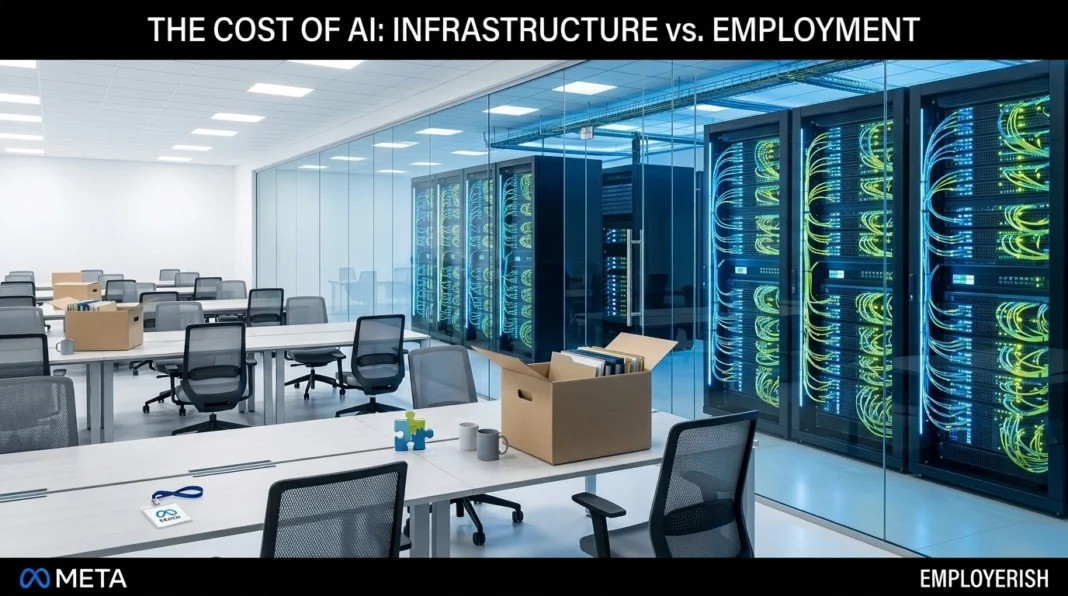
This isn't a case of a company struggling to keep the lights on. This is a cold, calculated trade-off. Meta is essentially firing 8,000 humans so they can afford a $135 billion bill for AI infrastructure. It’s the ultimate Hunger Games, and the odds are definitely not in the employees' favor.
The $135 Billion Trade-Off
Let’s look at the math, because the numbers tell a story that the PR department never will. Meta is reportedly investing a staggering $135 billion into AI servers, data centers, and the high-end hardware required to train the next generation of algorithms.
To put that in perspective, $135 billion is enough to pay those 8,000 employees their current salaries for several decades. But humans don't scale like GPUs. Humans need health insurance, maternity leave, and the occasional day off to avoid a mental breakdown. Servers? They just need electricity and liquid cooling.

By dumping $135 billion into "efficiency" while cutting the very people who built the platform’s current success, Meta is sending a clear signal: The era of the "knowledge worker" is being replaced by the era of the "model trainer," and even those roles are on thin ice.
The "Efficiency" Lie
In the corporate world, "efficiency" is the ultimate gaslighting term. It’s the word CEOs use when they want to tell Wall Street they’ve found a way to squeeze more blood from the stone.
When Zuckerberg talks about the "Year of Efficiency" (which has now apparently turned into the "Decade of Efficiency"), he isn't talking about better workflows or fewer meetings. He’s talking about shifting the payroll budget into the capital expenditure budget.
Every time a human is replaced by an automated system, the stock price gets a little bump. Why? Because algorithms don't ask for raises. This isn't about making the company "better" for the users; it’s about pumping stock prices to ensure executive bonuses remain in the stratosphere. While 8,000 families are wondering how they’ll pay their mortgages come June, the upper echelon is measuring their yachts for new curtains.
A Systemic Rot: You’re Not Alone
Meta isn't the only one playing this game. This is a systemic rot that is spreading across the entire tech landscape.
- Amazon is reportedly eyeing another 14,000 cuts in May, following their massive 16,000-person purge in January. They’re funneling $125 billion into their own AI infrastructure.
- Block (formerly Square) has been aggressively pruning its workforce under the same "efficiency" mandate, proving that even the "disruptors" are just as susceptible to old-school corporate bloodletting.
"AI" has become the new convenient excuse for old-school corporate pruning. In 2008, it was "the housing crisis." In 2020, it was "the pandemic." In 2026, it’s "the AI transition." The excuse changes, but the result is always the same: the people at the bottom pay for the pivots at the top.

The "Professional Troublemaker" Perspective: Your Job is an Income Stream
Here is the unfiltered truth that your HR department will never tell you: Your job is not your identity. It is an income stream.
At Employerish, we advocate for Dualpreneurship. In an era where 10% of a company can be deleted with a single press release, relying on one employer for your entire livelihood isn't just risky: it’s professional malpractice.
The "loyalty" that corporations demand is a one-way street. They want your 60-hour weeks, your passion, and your creative "soul," right up until the moment a GPU can do 70% of your job for 5% of the cost.
It is time to normalize "boomeranging." Go to corporate, get the bag, learn the skills, and then leave on your own terms: or stay just long enough to build your own side hustle. If Meta can treat 8,000 people like line items on a spreadsheet, you have every right to treat Meta like a high-paying client that you can fire at any time.

Don't Get Caught in the Crosshairs
The May 20th Massacre at Meta is a wake-up call for everyone in the digital economy. Whether you're in Menlo Park or working remotely from a beach in Bali, the "AI Hunger Games" are coming to a Slack channel near you.
The goal isn't to live in fear; the goal is to live with your eyes open. Stop buying into the "we’re a family" propaganda. Start building your own safety net. Start treating your career like a business, and your employer like just one of many stakeholders.
If you’re one of the 8,000, don’t let the "efficiency" lie get in your head. You weren't "inefficient." You were just more expensive than a server rack in a cooling shed in Iowa. That’s not a reflection of your value; it’s a reflection of Meta’s priorities.
Stay sharp. Stay cynical. Stay Employerish.
The Employerish Take
Meta is cutting 8,000 roles (10% of staff) on May 20th to fund a $135 billion AI infrastructure spend. This isn't "efficiency": it’s a calculated replacement of humans with hardware to satisfy Wall Street. This trend is systemic, with Amazon and Block following suit. The Takeaway: Your job is an income stream, not a marriage. Diversify your income, embrace dualpreneurship, and never trust a CEO who uses the word "efficiency" while holding a pink slip.
Looking for workplace news that actually tells the truth? Subscribe to Employerish for more unfiltered takes on the corporate theater.